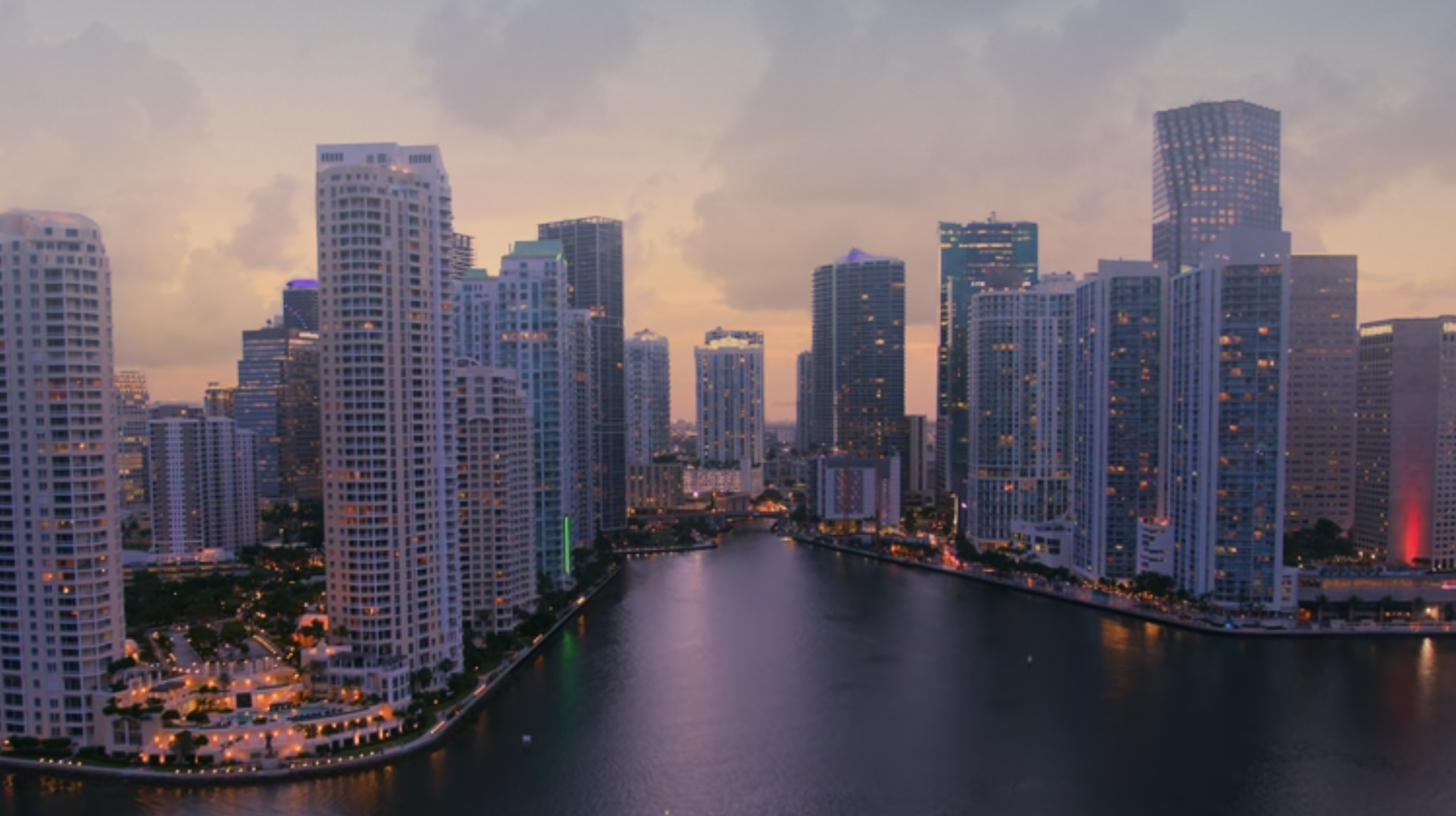
So many people visit Miami and Biscayne Bay without realizing the true foundation of the city isn’t just the beaches or nightlife — it’s the architecture. Yes, the water connects the neighborhoods, islands, and skyline, but the next biggest feature of Miami is what rises from the shoreline: bold design, dramatic height, and a city that was built to be seen.
That’s why an architecture cruise on Biscayne Bay is one of the easiest ways to understand Miami. From the bay, you don’t just spot buildings — you understand how Miami fits together. You see the scale, the skyline relationships, and the intention behind why certain towers dominate the horizon while others anchor the city’s history. From towering modern condos along Biscayne Bay to the Mediterranean Revival presence of the Freedom Tower, there’s an incredible amount to take in when you view it the way Miami was designed: from the water.
This Architecture Guide of Biscayne Bay is your definitive walkthrough to understanding Miami’s architecture from the bay — the architectural spine of the city. Inside, you’ll find the key styles and eras that shaped Miami, how different neighborhoods developed, and the landmark buildings that define the icon city today.
Quick links: Why Biscayne Bay Matters • Miami Modern • The Vision (1910s–1920s) • Architectural Eras • Night Architecture
Why Miami Architecture Is Best Seen From the Water
Miami’s most memorable architecture is designed to perform from a distance. The water gives you the distance. It also gives you the right angle.
From land, you’re often blocked by hedges, gates, setbacks, parking podiums, and private driveways. The “show” is hidden. From the water, you get a continuous reveal: the edges of islands, the bay-facing elevations, the skyline’s silhouette, and the relationship between civic buildings and the shoreline.
That’s also why Miami’s waterfront architecture feels different from other cities: it isn’t just “pretty buildings near water.” It’s architecture that assumes the viewer is floating. You see that clearly around Museum Park—where Pérez Art Museum Miami (PAMM) is explicitly oriented to the park, the water, and the city, designed as an open structure on Biscayne Bay.
And then there’s the “Miami paradox”: the city is vulnerable to climate risk, yet still builds bold waterfront statements anyway. That tension—aspirational design versus environmental reality—is part of the story, and you can feel it most from the bay. For the cleanest views, Miami Waterfront Boat Tours is the best starting point.
Why Biscayne Bay Is Central to Miami Architecture
The Magic City didn’t grow toward the water — it grew because of the water. Biscayne Bay became the city’s front door, its main sightline, and its highest-value edge from the start. The founders, or as we like to call them the architects, founded this town because of the palm trees and its proximity to the coastline.
- Waterfront-first growth: The bay (and the Miami River) anchored early settlement and movement, so the most important land naturally clustered near the water.
- Tourism + real estate followed the shoreline: As Miami grew as a destination, visibility and views made bayfront parcels the headline parcels.
- Why Downtown Miami & Brickell became dense: The most intense development sits at the bay's edge because water creates openness and prestige landlocked blocks can’t replicate. Who doesn't want to look out over the bay or the ocean?
- Islands built for waterfront living: The Venetian Islands and Star Island were planned around shoreline frontage—water access and views were the point. It was prestigious from the start.
- The bay makes the skyline readable: From land, towers get chopped up; from the water you see full elevations and how buildings form continuous skyline clusters.
- Glass + water doubles the effect: Reflections amplify modern towers at sunrise/sunset—one reason so many façades are designed to face the bay.
- Major landmarks face the bay on purpose: Miami’s biggest civic sightlines are bayfront, so signature public architecture is designed to address the water.
- Two anchor examples: Pérez Art Museum Miami and Phillip and Patricia Frost Museum of Science sit on the waterfront in Maurice A. Ferré Park, reinforcing the bayfront as the city’s architectural stage.
- Planning reinforces the pattern: Bayfront promenade projects (Baywalk/Riverwalk) aim to connect the shoreline into continuous public space—shaping what stays open and what becomes vertical.
Bottom line: Biscayne Bay is the city's architectural spine because it drove development patterns, it’s the clearest place to read the skyline, and it’s where the city puts its most visible, representative buildings.
Biscayne Bay Cannot Compete With Miami Beach and Its Art Deco Collection
Biscayne Bay isn’t where Miami’s Art Deco legacy lives — and it doesn’t try to be. Miami Beach’s Art Deco Historic District is one of the most concentrated and preserved collections of 1930s–1940s resort architecture in the world, defined by low-rise buildings, rounded corners, pastel façades, and street-level detail easily seen by a stroll down Ocean Drive. Biscayne Bay’s architectural value comes from a different direction: scale, height, and skyline composition viewed from the water, not walkable streetscapes.
Key differences between the two architectural experiences:
- South Beach's Art Deco is street-level, pedestrian, and detail-driven
- Biscayne Bay architecture is vertical, large-scale, and designed to be read at distance
- Art Deco emphasizes façades and ornament; bayfront architecture emphasizes massing, height, and reflection
- SoBe preserves a single historic era; Biscayne Bay shows multiple eras layered together
- Art Deco is best experienced on foot; Biscayne Bay architecture is best understood from the water
The Bay in Miami Is the Largest Collection of Miami Modern
While SoBe preserves the past, Biscayne Bay showcases Miami’s modern identity. The bayfront holds the city’s most concentrated collection of post-war modernism, contemporary glass towers, and supertall architecture—all designed around water-facing views, reflections, and skyline presence. This is where Miami’s architectural evolution is most visible in one continuous panorama, and where residents pay a premium to experience these views from their own living rooms.
Why Biscayne Bay defines Miami Modern architecture:
- The city’s tallest and most recognizable towers line the bayfront, opening sightlines toward Biscayne Bay and the Atlantic Ocean
- Floor-to-ceiling glass and bay-facing façades dominate residential design
- Multiple architectural eras coexist within a single skyline view
- Cultural institutions and civic buildings are intentionally placed along the bay
- Water reflections amplify scale, height, and nighttime illumination
Specific examples of Miami Modern architecture along Biscayne Bay
- One Thousand Museum – Sculptural, supertall residential tower by Zaha Hadid, instantly recognizable from the water for its exoskeleton design and skyline presence.
- Icon Brickell – A large-scale bayfront residential complex that helped define the post-2000 luxury condo boom, featuring floor-to-ceiling glass and expansive balconies oriented toward Biscayne Bay.
- Marquis Residences – One of the earlier glass residential towers on the bay, illustrating the shift toward full-height glazing and uninterrupted water views.
- Brickell Flatiron – A contemporary residential tower with strong vertical expression; its curved form and interior illumination are especially legible from the water at night.
- Pérez Art Museum Miami – A modern cultural institution intentionally designed to face the bay, elevated for flood resilience and integrated into the waterfront public realm.
- Phillip and Patricia Frost Museum of Science – A campus-style modern complex on Biscayne Bay, anchored by an illuminated planetarium dome that reinforces the bayfront as a civic and architectural stage.
- Waldorf Astoria Miami (under development) – Planned to become Florida’s tallest building, representing the next phase of Miami Modern and supertall architecture along the bay.
Together, these buildings show how Miami Modern architecture along Biscayne Bay prioritizes height, glass, water-facing design, and skyline presence—creating a continuous modern panorama that can’t be replicated anywhere else in the city.
The Vision of Biscayne Bay Begins in the 1910s–1920s
The city's architectural story does not begin with skyscrapers — it begins with engineering. Long before glass towers lined Biscayne Bay, the city’s founders made a deliberate decision: the bay itself would be the organizing feature of Miami’s growth.
In the early 20th century, leaders such as Carl G. Fisher, John S. Collins, and John N. Lummus envisioned Miami and Miami Beach as connected resort cities — places designed for leisure, visibility, and waterfront living. To make that vision real, Biscayne Bay was physically reshaped.
Dredging Biscayne Bay: Creating Land Where None Existed
Beginning in the 1910s and accelerating through the 1920s, large portions of Biscayne Bay were dredged. The material removed from the bay bottom was deposited to create new land, raise low-lying areas, and form entirely new islands. This was not incidental development — it was intentional city-building.
These man-made islands became some of Miami’s most architecturally distinctive residential zones, positioned between Downtown Miami and Miami Beach, developed long before environmental resources management became a formal consideration.
The Venetian Islands (1920s)
The Venetian Islands were created primarily in the early 1920s as part of a grand causeway effort spearheaded by Carl G. Fisher. The original Venetian Causeway was completed and opened in 1925, replacing the earlier wooden Collins Bridge (1913).
- Biscayne Island (added later, mid-20th century)
- San Marco Island
- San Marino Island
- Di Lido Island (originally named “Dildo Island”)
- Rivo Alto Island
- Belle Isle
These islands were marketed as exclusive residential enclaves inspired by European coastal living, reinforcing Miami’s early identity as a waterfront resort city. The name itself was directly inspired by Venice, Italy—hence the Venetian Causeway.
Palm, Hibiscus, and Star Islands (1910s–1920s)
Separate from the Venetian chain, three of Miami’s most famous man-made islands were developed slightly earlier or concurrently:
- Palm Island – created around 1919
- Hibiscus Island – created around 1916
- Star Island – created in 1922
These islands were also developed by Carl G. Fisher and his partners, designed specifically for luxury waterfront estates. Their curving shorelines, deepwater access, and separation from the mainland made them ideal for high-profile residential development — a pattern that still defines Biscayne Bay real estate today. Over the years, these islands have also become home to many high-profile individuals, forming the heart of what is now known as Miami’s Celebrity Homes Cruise.
Why This Matters Architecturally
- Waterfront-first development — the most valuable land faces the bay and Atlantic Ocean
- Architecture designed to be seen from the water, not just the street
- Bridges and causeways as urban connectors, not barriers
- Islands as architectural stages, setting the precedent for exclusivity, views, and scale
Before Miami had a skyline, it had a vision — and that vision placed Biscayne Bay at the center of the city’s identity.
Architectural Eras Along Biscayne Bay
Biscayne Bay tells Miami’s architectural story in layers. From the water, multiple eras appear side by side, revealing how the city evolved from a coastal resort town into a global skyline—balanced between the calm of Biscayne Bay and the Atlantic Coast beyond it.
Early Miami & Mediterranean Revival (1910s–1930s)
- Look/Style: stucco, arches, ornament, Spanish/Mediterranean influence
- Water-view clue: “Old Miami” details stand out against today’s glass towers
- Why it matters: established Miami’s resort-city identity before the modern skyline
- Real examples: Freedom Tower
Mid-Century Modern Growth (1940s–1960s)
- Look/Style: clean lines, horizontal massing, functional modernism
- Water-view clue: lower waterfront scale + marina-oriented planning patterns
- Why it matters: pushed Miami toward modern living and indoor/outdoor design
- Real examples: (add 2–4 bayfront mid-century survivors or districts)
Post-2000 Luxury Condo Boom (late 1990s–2000s)
- Look/Style: glass condo towers, wide balconies, bay-facing façades
- Water-view clue: a continuous “wall” of residential towers along the shoreline
- Why it matters: turned Biscayne Bay into the front yard for vertical luxury living
- Real examples: Icon Brickell; Marquis Residences
Contemporary Glass & Supertall Era (2010s–Present)
- Look/Style: taller, sculptural towers designed as skyline landmarks
- Water-view clue: icons read clearly from long distances across open water
- Why it matters: defines Miami’s current global skyline identity
- Real examples: One Thousand Museum; Waldorf Astoria Miami
Modern Waterfront Architecture in Downtown Miami
Downtown Miami’s transformation is most dramatic when viewed from Biscayne Bay. What was once a modest commercial district is now a dense, vertical skyline defined by glass, height, and proximity to the water.
Signature towers like Marina Blue and Paramount Miami Worldcenter illustrate how downtown architecture shifted toward residential and mixed-use development. These buildings emphasize reflective glass, slender profiles, and bay-oriented façades designed to capture light and water views.
The relationship between density and water is key. Downtown’s buildings are taller and more compact precisely because Biscayne Bay provides openness, sightlines, and breathing room. From the bay, the skyline reads as a continuous architectural composition rather than a collection of disconnected towers.
Brickell’s Architectural Identity From the Bay
Brickell’s skyline tells a different story. Originally Miami’s financial district, Brickell evolved into a hybrid zone where corporate architecture and luxury residential towers coexist.
Corporate landmarks like Brickell City Centre introduced large-scale mixed-use design, integrating offices, retail, and climate-responsive architecture. Meanwhile, residential icons such as Asia Brickell Key and Echo Brickell emphasize sleek vertical living.
From Biscayne Bay, Brickell appears more vertical and tightly clustered than Downtown. The water accentuates the contrast between glass towers and the narrow land footprint, making Brickell one of the most visually striking waterfront skylines in the U.S.
Iconic Biscayne Bay Landmarks You See From the Water
Some of Miami’s most important buildings are designed to be viewed from Biscayne Bay. From the water, the bayfront reads like a curated architectural corridor: cultural institutions, skyline icons, and civic waterfront space stitched into one panorama.
Cultural Institutions
- Pérez Art Museum Miami (PAMM): elevated platforms and hanging gardens interacting with the bay
- Phillip and Patricia Frost Museum of Science: terraces and observation decks facing the water
Skyline-Defining Towers
- One Thousand Museum: exoskeleton design, instantly recognizable from the bay
Waterfront Civic Architecture
- Bayside developments and public waterfront parks framing the skyline
- Bayfront open space reinforcing Biscayne Bay as both civic stage and architectural showcase
How Architecture Changes From Day to Night on Biscayne Bay
Miami’s skyline is built to perform after dark. At night, lighting becomes part of the architecture—and from Biscayne Bay you can actually read how towers, museums, bridges, and waterfront parks were designed to be seen. This transformation is central to understanding Miami’s skyline and is explored in more depth on Miami Architecture Night Cruises.
Interior glow reveals structure (the “floor plate” effect)
During the day, glass towers read as reflections. At night, they become transparent enough to show stacked floors, vertical rhythm, and setbacks—the actual geometry of the building.
- What to look for: repeating balcony lines, lit amenity decks, and the “ladder” pattern of residential floors
- Real examples: clusters in Brickell and Downtown Miami (especially the residential wall facing Biscayne Bay)
Signature “icon lighting” makes certain buildings unmistakable
- One Thousand Museum: exoskeleton reads as a sculptural form; widely described as lighting up as a recognizable beacon on the skyline
- Frost Museum of Science: planetarium dome externally illuminated; the complex planned with nighttime illumination in mind
Reflections turn the skyline into a “double city”
- What to look for: skyline doubling under calm water, stronger contrast after sunset, long vertical reflections
- Why it matters: reflections change perception—height feels taller and clusters feel denser because you’re seeing twice the visual mass
Bayfront civic buildings are designed to face the night public realm
- PAMM + Frost: sit directly on the waterfront in Maurice A. Ferré Park—one of the most architectural night views in the city
Put together, this is why Biscayne Bay at night isn’t just a prettier version of the skyline — it’s a clearer way to understand it. The interior glow exposes structure, icon lighting makes landmarks instantly identifiable, and the water doubles the composition with reflections you can’t get from land.
Biscayne Bay Neighborhoods & Their Architectural Styles
- Downtown Miami: dense, modern, and vertical — a mix of residential and cultural architecture designed to front the bay
- Brickell: high-rise financial and luxury residential towers with strong vertical emphasis and minimal setbacks
- Venetian Islands: low-rise luxury homes, mid-century influences, and Mediterranean Revival details set against open water
- Edgewater: emerging residential towers with wider spacing and panoramic bay views, bridging downtown density and residential calm
Together, these neighborhoods form a continuous architectural narrative along Biscayne Bay.
Why Seeing Miami Architecture From the Water Matters
Architecture along Biscayne Bay was designed with the water in mind. From a boat, you see full elevations, skyline relationships, and building intent that streets simply can’t reveal. Sightlines are uninterrupted. Scale becomes legible. The skyline reads as a unified composition rather than fragments between blocks.
This perspective isn’t optional — it’s essential to understanding Miami’s architecture.
Best Way to Experience Biscayne Bay Architecture
A guided architecture cruise offers what land-based exploration cannot: continuous sightlines, expert narration, and a calm, unobstructed environment. Without traffic, elevation changes, or visual clutter, the architecture becomes the focus — exactly as it was intended.
Biscayne Bay Is Only One Part of Miami’s Architectural Story
Biscayne Bay offers the clearest, most concentrated view of Miami’s modern skyline—but it’s not the whole picture. Across Miami-Dade County, architecture shifts by neighborhood, era, and scale, revealing how Miami developed beyond the water’s edge. Seeing the bay first gives you the context; exploring the city completes the story.
Architectural areas that add context beyond the bay
- South Beach: historic Art Deco streetscapes and preserved resort-era design
- Coral Gables: Mediterranean Revival planning with civic-scale architecture
- Little Havana: cultural architecture tied to migration, commerce, and street life
- Wynwood: adaptive reuse, industrial structures, and contemporary creative design
- Coconut Grove: early residential architecture and tropical modern influences
How this connects naturally
After understanding Miami’s skyline from the water, many visitors choose to explore these districts on land through Miami Architecture City Tours—a 3.5 hour guided way to connect Biscayne Bay’s big-picture architecture with the neighborhoods that shaped the city at street level including Miami Beach, Wynwood, Little Havana and the entire Downtown Miami Skyline.
Additional Biscayne Bay & Bay-Visible Buildings Worth Mentioning
Downtown Miami / Museum Park / Bayfront Core
- Adrienne Arsht Center for the Performing Arts: major cultural anchor north of Museum Park
- Bayfront Park Amphitheater: waterfront civic space shaping the bayfront experience
- Miami Tower: programmable LED lighting; one of the most recognizable night skyline elements
Brickell / Brickell Key
- Four Seasons Hotel Miami: long-time height benchmark before the supertall era
- Carbonell: defining residential tower on Brickell Key, legible from the bay
- Asia Brickell Key: bay-island residential landmark
Edgewater / North Bayfront
- Missoni Baia: brand-driven waterfront residential architecture
- Aria on the Bay: twin-tower composition that reads clearly from the water
- Paraiso Bay: large-scale residential planning along the bay
Historic / Transitional Bayfront Structures
- Miami Herald Building (former): significant mid-century modernist waterfront presence
- Freedom Tower: historic Mediterranean Revival anchor and skyline counterpoint to glass towers
Miami River (Adjacency, not pure bay)
- Rivergate Plaza: early modern office tower linking river + bay history
- Epic Residences: where river and bay meet; mixed waterfront conditions
Miami-Dade County Has Far More to See Than Biscayne Bay Alone
Biscayne Bay is the architectural spine of Miami, but it’s only one part of a much larger landscape. When we talk about architecture in Miami-Dade County, we’re not just talking about buildings — we’re talking about how land, water, infrastructure, and history shape the built environment.
Notable areas and landmarks beyond the bayfront skyline
- Virginia Key: barrier island with historic infrastructure and cultural landmarks
- Boca Chita Key: within Biscayne National Park; early 20th-century recreational/maritime structures
- Key Biscayne: island community shaped by causeways, coastal exposure, and preserved parkland
- Cape Florida Lighthouse: built in 1825; early coastal navigation and infrastructure on Key Biscayne
- Florida Keys: architecture shifts to coastal engineering—bridges, marinas, conch-style homes, hurricane-resilient building techniques
How this fits into the bigger picture
Seeing Biscayne Bay first provides the context — the skyline, scale, and modern identity of Miami. Exploring the wider county reveals how architecture adapts beyond density, responding instead to isolation, nature, navigation, and preservation.
Architecture Gems We Lost
Miami is built on momentum—bigger projects, taller skylines, and constant reinvention. But that growth has a cost: when redevelopment moves faster than preservation, historically meaningful buildings can disappear before most people realize what they were. Unless a property fights hard to be recognized as a National Historic Landmark—and protected early— it can be replaced permanently, taking a piece of Miami-Dade’s architectural identity with it.
Lost in Miami (City of Miami / Miami-Dade)
- Miami Herald Building: modernist newsroom complex on Biscayne Bay (HQ 1963–2013); demolition began in 2014
- Bobby Maduro Miami Stadium: opened 1949; known for cantilevered roof; demolished in 2001
- Miami Orange Bowl: opened 1937; iconic civic venue; demolished in 2008
- Tobacco Road: century-plus riverfront building; closed and demolished in 2014
- Amertec Building: local landmark symbol of “lost Miami”; demolished in 2017
Lost in Miami Beach
- Deauville Beach Resort: mid-century resort landmark; demolished in 2022
- Biscaya Hotel: major bayside hotel example; demolished in 1987
- Poinciana Hotel: noted Art Deco-era hotel; demolished in 1988
- Senator Hotel: designed by L. Murray Dixon; demolished in 1988
- Sands Hotel: 1939-era loss; demolished in 1992
Unique Architecture of Miami Includes Coral Rock
Long before glass towers defined the skyline, Miami was built from what the land itself provided. Coral rock (oolitic limestone)—quarried locally—became one of South Florida’s earliest building materials. Its porous texture, pale color, and durability made it ideal for the tropical climate.
Notable historic coral rock buildings in Miami-Dade County
- Coral Castle: carved coral limestone landmark built by Edward Leedskalnin
- Woman's Club of Coconut Grove: completed in 1921; one of Miami’s finest coral rock civic buildings
- Plymouth Congregational Church: built in 1917; coral rock religious landmark
- St. Stephen's Episcopal Church: early 20th-century coral rock church in Coconut Grove
- Miami City Hall: coral rock used extensively in Coral Gables civic architecture
- Historic coral rock homes in Coconut Grove: early residential examples (1910s–1920s)
Why coral rock architecture matters
These structures show how Miami’s earliest builders adapted to climate, geography, and available materials. Coral rock architecture connects the city directly to its natural environment—and stands in sharp contrast to the modern glass skyline that came later.
The Nature of Biscayne Bay and the Bridges That Connect It
As much as we give credit to the founding fathers and the architects who shaped Miami, the city itself also makes SoFlo different than the entire world. Biscayne Bay isn’t just scenery—it’s the natural flow through the city, the views, the palm trees, and the outdoor life that ties everything together.
Miami is changing fast. More construction and each new project forces the city to think about more outdoor spaces—waterfront access, parks, promenades, and places where people can actually experience the bay.
What makes Biscayne Bay unique
- Beautiful views and open water sightlines
- Palm trees and a true outdoor lifestyle
- A natural flow through the city by boat, bridge, and shoreline
- The coral reefs off the East Coast of Florida
- Many different outdoor activities built into daily life
- Constant change that increases the need to preserve open space
Each main artery brings you to different areas of this wonderful place. The Rickenbacker Causeway and MacArthur Causeway don’t just connect roads—they connect architecture, islands, and the way people experience Miami.
What these bridges connect
- Rickenbacker Causeway: gateways to islands, parks, and open-water scenery
- MacArthur Causeway: direct access between the bayfront skyline and Miami Beach corridors
- Both: skyline views, waterfront neighborhoods, and the tourism routes people actually use
Tourism helps bring people to our area—but it’s our job to preserve this area and architecture. Miami started as a vacation town much like Key West, but it outgrew that identity into a major waterfront city built around Biscayne Bay.
Biscayne Bay Architecture Guide: Understanding Miami’s Skyline From the Water
Biscayne Bay is Miami’s architectural showcase — a place where history, design, and ambition converge along the water. This guide exists to help you understand the buildings, eras, and neighborhoods that define the skyline. Explore related architecture guides, dive deeper into specific styles, and experience Miami from the perspective that reveals it best: the bay.